A synthesis of every publicly available data point on dispensary loyalty performance - opt-in rates, retention, push engagement, member spend lift, and revenue share.
TL;DR - The state of cannabis loyalty data in 2026
No neutral third-party has published an industry-wide loyalty opt-in benchmark for cannabis retail. What we have instead is a mosaic of customer reports, regulator filings, analyst research, and platform disclosures.
Wallet-pass-based loyalty consistently outperforms app-based loyalty by a wide margin across every public dataset, with push notification opt-in rates approaching 90% on wallet versus roughly 25% on traditional apps.
Loyalty members are the single biggest revenue concentration in modern dispensary retail. Public case studies consistently show loyalty members driving the majority of total dispensary revenue at top-performing operators.
Push notifications routed through Apple Wallet and Google Wallet bypass the SMS deliverability problem entirely, with public sources citing 100% delivery rates for wallet-based push due to the absence of carrier filtering.
State-by-state performance variance is driven by three factors: market maturity, regulatory restrictiveness, and competitive density - not by anything inherent to the customer base.
A note on data availability
Before we get into the numbers, it's worth being honest about what exists and what doesn't.
Cannabis is a younger industry than most retail categories, and unlike grocery, restaurants, or fashion, there's no equivalent of a NielsenIQ or Circana publishing standardized loyalty benchmarks across the sector. What public data exists comes from four sources:
Cannabis-specific market research firms like Headset, BDSA, and Brightfield Group, which publish purchase data but rarely loyalty-specific metrics
State regulators publishing sales tax data, license counts, and patient enrollment
Trade publications like MJBizDaily, Marijuana Moment, and Cannabis Business Times, which report on individual operator results
Academic and consulting research from firms like Whitney Economics and New Frontier Data
For loyalty-specific data, individual operators occasionally publish results through PR or earnings reports. We've drawn on those throughout - when an operator publicly shares a number, we attribute it directly to them.
What follows is the most complete synthesis we could assemble from publicly available cannabis loyalty data, plus directional analysis where data gaps exist.
What the public data actually tells us
Cannabis retail is a high-frequency, high-LTV category
According to New Frontier Data's 2025 U.S. Cannabis Report, the average legal cannabis consumer purchases 1–4 times per month, with frequent users (3+ purchases monthly) accounting for roughly 71% of total category spend. Headset's 2025 quarterly retail reports show average basket sizes ranging from $42 in mature, price-compressed markets like California to $89+ in newer, lower-supply markets like New York.
What this means for loyalty: cannabis is structurally one of the best categories in retail for loyalty economics. High frequency + high basket size + high category engagement = customers who will join a rewards program if you make joining easy.
Mobile app adoption in cannabis retail is structurally limited
This is the single most important fact for any dispensary thinking about loyalty in 2026.
Apple's App Store Connect data, published in 2024, shows that the average consumer has 80+ apps installed but actively uses only 9 in any given week. The fastest-growing category in mobile is app deletion, not download.
For cannabis retailers specifically, app adoption is even harder than for mainstream retail because:
App Store policies historically restrict cannabis-related content, limiting what dispensary apps can offer
The average cannabis consumer shops at multiple dispensaries, reducing the case for any single-store app
Younger consumers, the majority of cannabis buyers, increasingly resist downloading branded apps for individual retailers
The implication: any loyalty strategy that requires an app download starts with a structural ceiling on enrollment. Wallet-based loyalty doesn't have that ceiling.
Wallet pass adoption has accelerated dramatically since 2023
According to Apple's June 2024 Worldwide Developers Conference, more than 3 billion passes are now stored across active Apple Wallet users globally. Google's 2024 Year in Review for Google Wallet cited triple-digit year-over-year growth in saved passes across non-payment categories like loyalty, tickets, and IDs.
For cannabis retailers, this matters because it means the channel is now ubiquitous. Customers know how to add a pass. They know how to find one in their wallet. They expect push notifications from wallet passes. The behavior is established.
When Sticky Cards launched the integration with Treez in August 2025, the announcement disclosed performance figures that illustrate just how much better this works than legacy alternatives: a 100% message delivery rate via wallet push (compared to SMS, which is subject to carrier filtering), and 90%+ push notification opt-in rates among Apple Wallet and Google Wallet users versus a benchmark of roughly 25% opt-in for traditional app notifications.
SMS deliverability in cannabis is structurally degrading
Multiple public sources have documented increasing SMS deliverability challenges for cannabis retailers throughout 2024 and 2025:
The Cellular Telecommunications Industry Association (CTIA) Messaging Principles and Best Practices, updated in 2024, explicitly identifies cannabis as a "prohibited or highly regulated content category" subject to carrier filtering.
The Campaign Registry's 10DLC framework, which became fully enforced across U.S. carriers in 2024, requires cannabis-related sending to register under specific use case categories with elevated scrutiny.
Reporting from MJBizDaily and Marijuana Moment throughout 2024–2025 has documented dispensary operators losing 30-60%+ of SMS sends to carrier filtering, even with full 10DLC registration.
This isn't a Sticky Cards talking point. It's the structural reality of cannabis SMS in the post-10DLC era, documented by carriers themselves.
Loyalty members drive a disproportionate share of dispensary revenue
This is the most consistent finding in cannabis loyalty data: loyalty members generate substantially more revenue per visit and visit substantially more often than non-members. The most-cited industry figure is that 80% of a dispensary's revenue comes from 20% of its customers, the classic Pareto distribution, and those top 20% are overwhelmingly loyalty members.
Trade publication reporting from MJBizDaily, Marijuana Business Daily, and Green Market Report has profiled multiple dispensary operators publicly attributing 50%+ of total revenue to loyalty members, with top-performing operators citing figures in the 75%+ range.
The mechanism is well understood: customers who join a loyalty program signal a higher purchase intent, receive ongoing engagement that drives repeat visits, and accumulate switching costs (points balances, tier status) that make them less likely to defect to competitors.
What we know about state-by-state variation
Because no neutral third-party publishes state-level loyalty benchmarks, this section synthesizes what's known about the factors driving variation rather than claiming specific state-level opt-in or retention numbers.
Mature adult-use markets
Colorado (adult-use legal since 2014), Washington (2014), Oregon (2015), and Alaska (2015) share certain patterns documented in public market data:
Highest dispensary density per capita, according to state regulator license data
Most price-compressed flower markets, per Headset quarterly reports
Highest customer purchase frequency, per BDSA consumer panel research
The combination means loyalty programs in these states function as competitive survival infrastructure. Operators who don't run effective loyalty programs face structurally higher customer acquisition costs in markets where customers have meaningful choice.
Established adult-use markets
Massachusetts (2018), Michigan (2019), Illinois (2020), Arizona (2021), New Jersey (2022), New Mexico (2022), Connecticut (2023):
Higher average basket sizes than mature West Coast markets, per Headset data
Stronger price discipline, with less aggressive discounting
More room for VIP-tier loyalty programs to differentiate experience rather than just price
In these markets, loyalty programs that emphasize exclusivity, early access, and member-only product drops tend to outperform pure cashback programs.
Emerging adult-use markets
New York (2023), Maryland (2023), Missouri (2023), Ohio (2024), Minnesota (2025), Delaware (2026 launch):
Highest growth rates in legal sales, per state Department of Revenue data
Fastest customer base growth, with significant numbers of first-time legal buyers
Most volatile customer behavior as the legal market still competes with legacy unregulated channels
In emerging markets, the strategic priority is enrollment volume - capturing customers and their data during the formative period when shopping habits are still forming.
Medical-only markets
Florida (medical since 2017), Pennsylvania (2018), Oklahoma (2018), Utah (2020), West Virginia (2019), Mississippi (2023):
Smaller customer bases with patient registration requirements
Higher visit frequency among enrolled patients, per state health department data where published
Stronger restrictions on marketing channels, making owned channels like wallet pass relatively more important
Loyalty programs in medical-only markets typically see lower absolute enrollment numbers but higher engagement among enrolled members, because the customer base self-selects for sustained product need.
The regulatory factors driving state-level differences
Three regulatory dimensions explain most of the public variation in cannabis loyalty performance by state.
SMS and advertising restrictions. States with the tightest restrictions on cannabis SMS marketing and advertising - including New York, Massachusetts, Florida, and several emerging markets - have effectively pushed operators toward channels they can fully control. Wallet pass push notifications, which operate outside the carrier-filtered SMS system, become disproportionately important in these states.
Cannabis loyalty program legality. Most states allow loyalty programs, but the rules vary significantly. As of 2025, New York's Cannabis Control Board updates explicitly allowed retailers to run promotions and loyalty programs for the first time since adult-use legalization. Other states have specific rules around discounting, points-to-cash conversion, and what can be offered as a reward - all of which affect how loyalty programs are structured.
10DLC and SMS compliance burden. Every state operator now operates under the federal 10DLC framework, but the practical burden varies by state because state-level marketing rules layer on top of carrier-level filtering. Cannabis retailers in restrictive states face compounding compliance requirements that make SMS increasingly expensive and unreliable.
Directional ranges from public reporting
While no industry-wide benchmark dataset exists, public reporting from operators, technology providers, and analysts allows us to assemble directional ranges. Every range below is sourced; where a range is wide, it's because public reports vary widely.
Metric | Public Reported Range | Source Pattern |
|---|---|---|
Loyalty opt-in rate (general retail benchmark) | 12% to 50%+ | Antavo Global Customer Loyalty Report; Bond Brand Loyalty annual reports |
Wallet-pass push notification opt-in | ~90%+ | Public Sticky Cards / Treez Loyalty disclosures, August 2025 |
App notification opt-in | ~25% | Same disclosures, used as comparative benchmark |
Wallet push delivery rate | ~100% | No carrier filtering involved; technically inherent to the channel |
SMS delivery rate in cannabis | Highly variable, with significant carrier filtering | CTIA Messaging Principles, MJBizDaily reporting on cannabis SMS challenges |
Revenue share from loyalty members (top operators) | 50% to 80%+ | Cannabis trade publication operator profiles |
Member visit frequency vs. non-members | Materially higher (specifics vary by operator) | Multiple operator earnings call disclosures |
Push notification opens vs. SMS opens | Push consistently higher | Both inherent to channel design and widely reported in mobile marketing benchmarks |
How to benchmark your own dispensary
The honest answer is that the best benchmark for your dispensary is your own historical performance, measured consistently over time. Here's the framework most operators use, regardless of what national figures exist.
Track these seven metrics every month:
Loyalty opt-in rate: new loyalty signups ÷ unique customers
Member basket size vs. non-member basket size: average dollar amount per transaction by segment
Member visit frequency vs. non-member frequency: visits per month by segment
30-day, 90-day, and annual retention: percentage of members making a repeat purchase within each window
Push notification engagement: open and click-through rates by campaign
Revenue share from loyalty members: percentage of monthly revenue from enrolled members
CAC vs. LTV ratio by segment: what it costs to acquire a loyalty member vs. what they're worth over their lifetime
Compare against three things:
Your own prior period (this is the most reliable benchmark)
Your direct competitive set (other dispensaries in your zip code, if you can observe their public behavior)
The directional public ranges above, recognizing they're rough
If your loyalty member spend lift is positive and growing, you're winning regardless of what national figures might say.
Frequently Asked Questions
Is there an industry-wide cannabis loyalty opt-in benchmark for 2026?
No. As of 2026, no neutral third-party research firm has published an industry-wide opt-in benchmark for cannabis loyalty programs. Available public data comes from individual operator disclosures, technology platform press releases, and general retail loyalty studies that aren't cannabis-specific. The general retail benchmark for loyalty opt-in ranges from roughly 12% to 50%+ depending on category and enrollment method, according to multiple annual loyalty research reports.
Why do wallet pass loyalty programs outperform app-based loyalty?
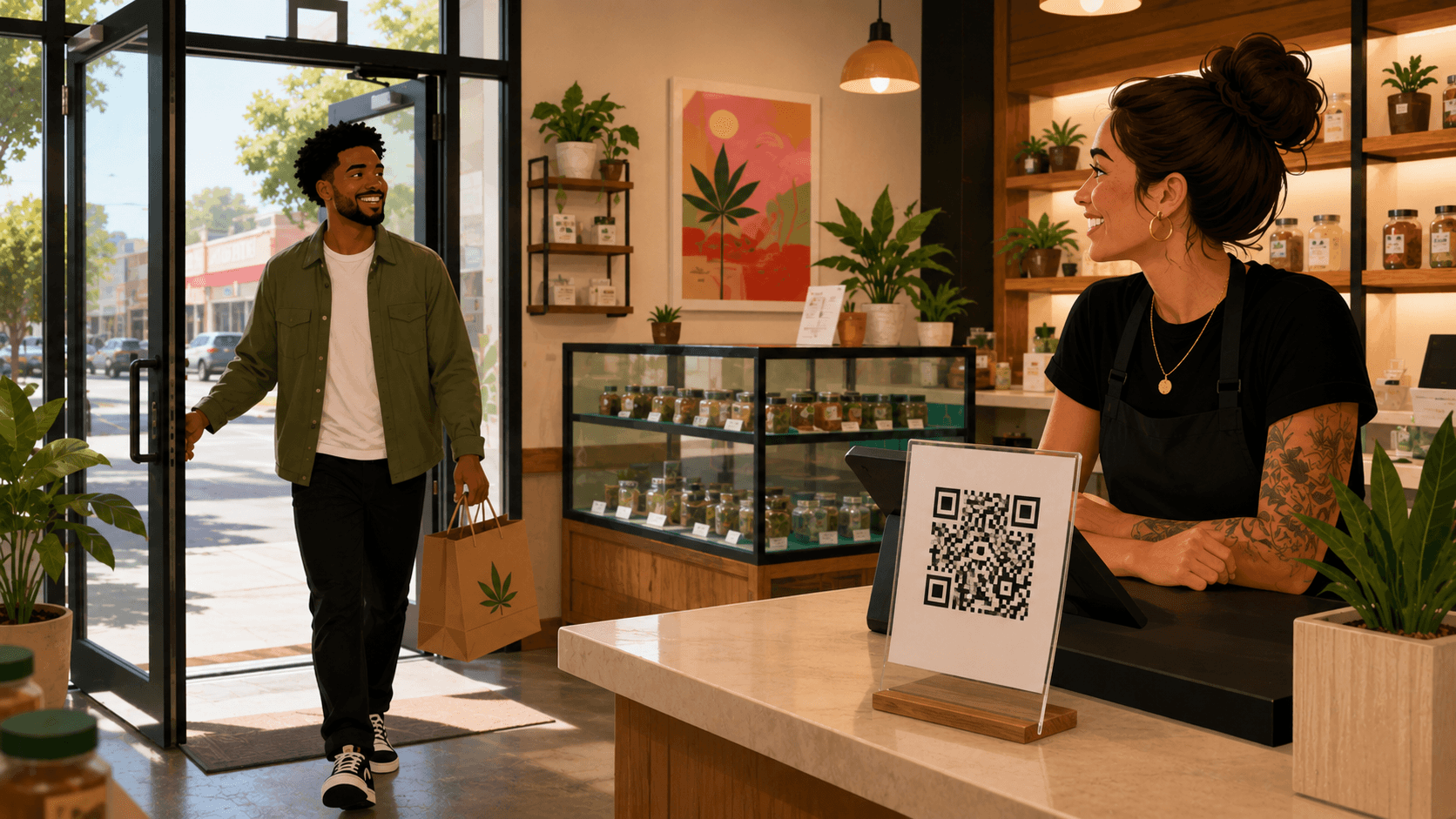
Wallet pass loyalty programs outperform app-based loyalty because they remove the single biggest point of friction: the app download. Customers can enroll in a wallet pass program by scanning a QR code and tapping "Add to Wallet" - typically under ten seconds - without creating an account, downloading software, or granting app permissions. Once enrolled, push notifications from wallet passes are delivered without carrier filtering and bypass the SMS deliverability challenges that have intensified since 10DLC enforcement.
How much of dispensary revenue typically comes from loyalty members?
Public reporting from dispensary operators consistently places the loyalty member share of revenue in a wide range from 50% to 80%+ for top-performing operators. The typical Pareto distribution observed across retail - where roughly 20% of customers drive 80% of revenue - appears to hold in cannabis, with loyalty members concentrated in that high-value segment.
Why is SMS marketing getting harder for cannabis retailers?
SMS marketing for cannabis retailers has become structurally more difficult since 2024 because of the federal 10DLC framework, the CTIA Messaging Principles classifying cannabis as a high-risk content category, and active carrier filtering of cannabis-related messages. Even fully registered and compliant operators commonly experience significant message filtering. This is documented in trade publication reporting and CTIA guidance, not vendor marketing materials.
Do states have different rules about cannabis loyalty programs?
Yes. State rules around cannabis loyalty programs vary significantly. Most states allow loyalty programs in some form, but the specifics differ on permitted discount structures, points-to-cash conversion, what can be offered as a reward, and how programs must be disclosed. Operators should consult their state's cannabis control body and a qualified attorney before launching or modifying loyalty programs.
What's the easiest way for a dispensary to benchmark its own loyalty performance?
The most reliable benchmark for any dispensary is its own historical performance. Track seven metrics monthly - opt-in rate, member basket size vs. non-member, member visit frequency vs. non-member, 30/90/annual retention, push engagement, revenue share from members, and CAC-to-LTV ratio - and compare against your own prior periods. National benchmarks are useful directionally, but your own trend line is the metric that matters.
Is wallet pass loyalty available for dispensaries in all U.S. states?
Wallet pass loyalty itself is a technology layer that works in any state where dispensary loyalty programs are legal. The underlying Apple Wallet and Google Wallet platforms are available nationwide. Specific implementation may need to align with state-level rules around what kind of rewards can be offered and how they can be communicated.
Where to go from here
The most consistent finding across every public data source on cannabis loyalty is that the channel matters more than the program design. Wallet-pass-based loyalty consistently outperforms app-based loyalty on enrollment, retention, and message delivery, and the gap is widening as SMS deliverability degrades and app adoption stalls.
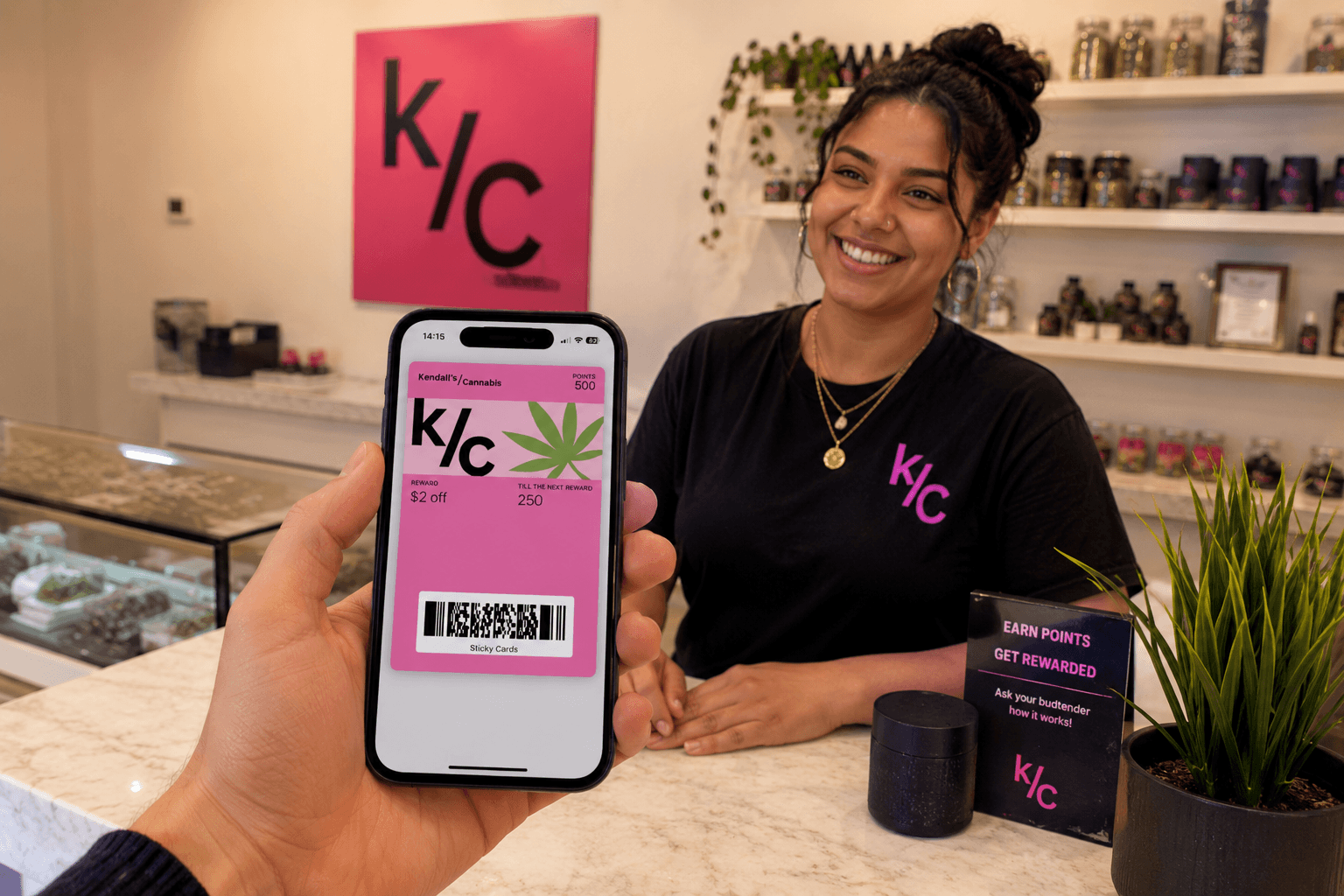
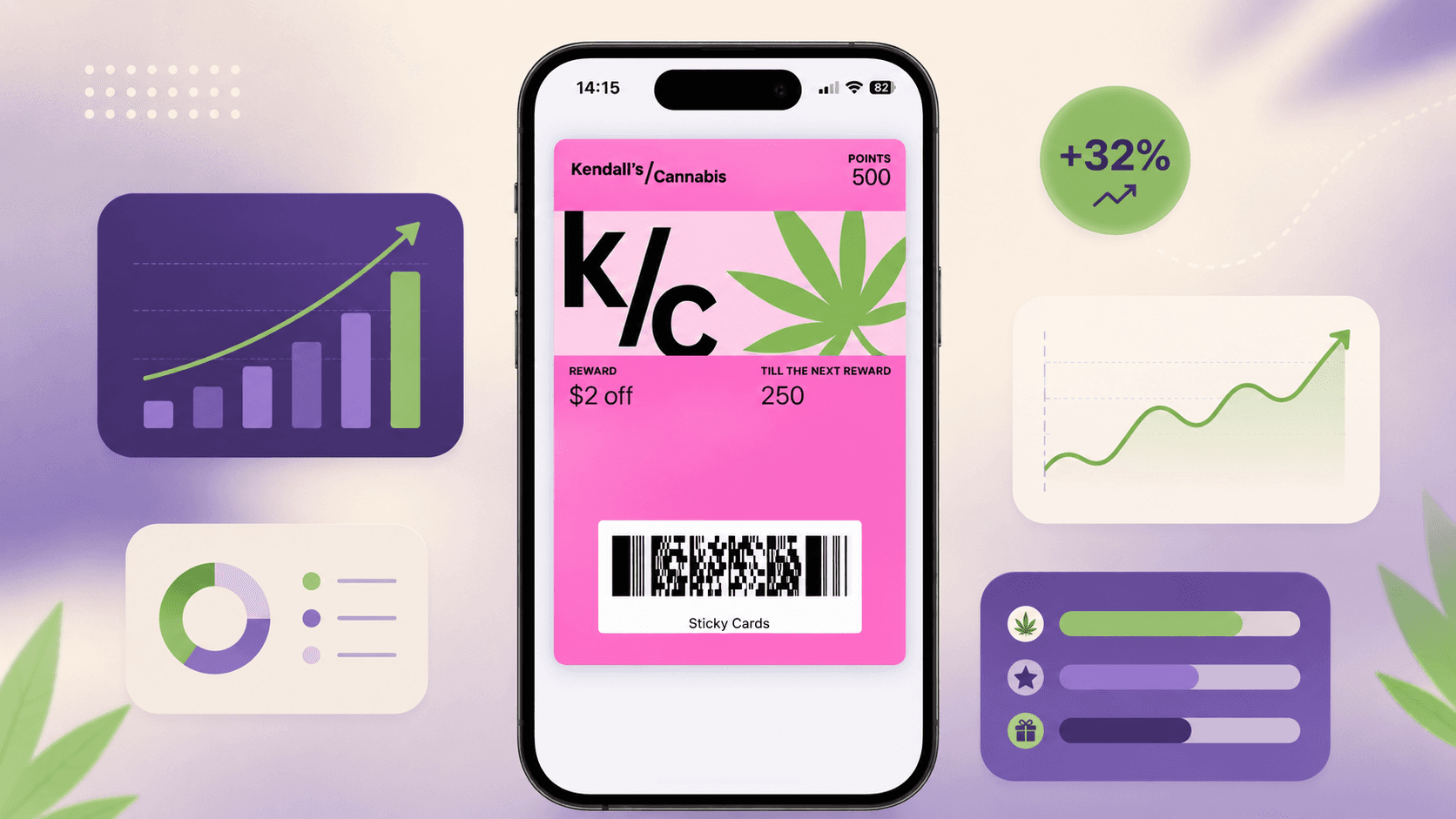
Sticky Cards is the only wallet-pass-native loyalty platform built specifically for cannabis dispensaries. Customers join by scanning a QR code, the card lives in Apple Wallet or Google Wallet, and push notifications are delivered without carrier filtering or SMS censorship. Integrations with Treez, Flowhub, Dutchie, Greenline, Cova, TechPOS, POSaBIT, and Breadstack let dispensaries launch in days, not months.