The single most important number in dispensary marketing, explained in plain English - with a worked example you can copy for your own store.
Reading time: ~6 minutes.
TL;DR
Customer Lifetime Value (CLTV) is the total profit you earn from a customer over the entire time they shop with you. It's the number that tells you how much you can afford to spend acquiring and retaining customers.
The simple formula is: Average Purchase Value × Purchase Frequency × Customer Lifespan × Gross Margin.
For a typical dispensary, CLTV ranges from a few hundred dollars to well over $2,000 depending on visit frequency and retention.
Loyalty members have dramatically higher CLTV than non-members because they visit more often and stay customers longer.
The fastest way to increase CLTV isn't acquiring more customers - it's increasing the frequency and lifespan of the ones you already have, which is exactly what a loyalty program is designed to do.
What is customer lifetime value?
Customer Lifetime Value (CLTV, sometimes written LTV) is the total amount of profit a single customer generates for your dispensary over the entire duration of their relationship with you - from their first visit to their last.
It answers the most important question in retail marketing: how much is a customer actually worth?
Once you know that number, almost every other marketing decision gets easier:
How much you can afford to spend acquiring a new customer
Whether your loyalty program is paying for itself
Which customer segments deserve the most attention
How much a single percentage point of retention is worth to your business
Most dispensary operators run their marketing on gut feel because they've never calculated CLTV. The ones who calculate it consistently make better decisions about where to spend, because they're working from a real number instead of a guess.
Why CLTV matters more in cannabis than in most industries
Cannabis retail has three characteristics that make CLTV especially important.
Customer acquisition is expensive and getting more expensive. Cannabis operators can't run Google Ads or Meta ads the way other retailers can. The marketing channels that are available - SMS, in-store signage, local partnerships, geo-targeting - all cost real money. The harder it is to acquire a customer, the more it matters to understand what that customer is worth once you have them.
Customers shop at multiple dispensaries. The average cannabis consumer isn't loyal by default. They'll shop wherever the deal is best on a given day unless you give them a reason to come back. That makes retention - and therefore CLTV - the central battleground.
Frequency is high. Unlike a furniture store where a customer might buy once every few years, cannabis customers buy frequently. That high frequency means small improvements in retention and visit frequency compound into large CLTV gains quickly.
Put together, these mean CLTV isn't an academic exercise for dispensaries. It's the number that determines whether your marketing budget is an investment or a leak.
The CLTV formula, explained
Here's the standard formula, broken into its four components:
CLTV = Average Purchase Value × Purchase Frequency × Customer Lifespan × Gross Margin
Let's define each piece in plain English:
Average Purchase Value (APV): How much a customer spends in a single transaction, on average. If your average basket is $55, your APV is $55.
Purchase Frequency (PF): How many times a customer buys from you in a given period, usually measured per year. If a customer visits twice a month, their annual frequency is 24.
Customer Lifespan (CL): How many years, on average, a customer keeps shopping with you before they stop. If your typical customer stays for three years, your customer lifespan is 3.
Gross Margin (GM): The percentage of revenue you keep after the cost of goods. If you buy products for 50 cents on the dollar, your gross margin is 50%. We multiply by this because CLTV measures profit, not revenue.
Step-by-step: calculating CLTV for a dispensary
Let's work through a complete example using realistic numbers for a mid-sized independent dispensary. Follow along with your own numbers as we go.
Step 1: Calculate Average Purchase Value
Take your total revenue over a period and divide it by the number of transactions in that period.
Example: $200,000 in monthly revenue ÷ 3,600 transactions = $55.56 average purchase value
Step 2: Calculate Purchase Frequency
Take your total transactions over a period and divide by your number of unique customers.
Example: 3,600 transactions/month ÷ 1,500 unique customers = 2.4 visits per month → 28.8 visits per year
Step 3: Estimate Customer Lifespan
This is the trickiest number to pin down, and it's where most dispensaries are losing money without realizing it. Customer lifespan is the inverse of your churn rate.
If 40% of your customers stop shopping with you each year (churn rate of 0.40), your average customer lifespan is 1 ÷ 0.40 = 2.5 years
Step 4: Determine Gross Margin
Use your actual blended gross margin across all products.
Example: 50% gross margin (a common dispensary figure)
Step 5: Multiply it all together
CLTV = $55.56 × 28.8 × 2.5 × 0.50 CLTV = $2,000 per customer
So in this example, the average customer is worth $2,000 in gross profit over their lifetime. That single number now anchors every marketing decision you make.
The CLTV table: see how the levers move the number
Here's where it gets interesting. Look at what happens to that $2,000 CLTV when you change just one variable at a time.
Scenario | What changes | New CLTV | % change |
|---|---|---|---|
Baseline | — | $2,000 | — |
Increase APV by $10 | $55.56 → $65.56 | $2,360 | +18% |
Add 6 visits/year | 28.8 → 34.8 | $2,417 | +21% |
Extend lifespan by 1 year | 2.5 → 3.5 years | $2,800 | +40% |
Reduce churn from 40% to 30% | Lifespan 2.5 → 3.3 years | $2,667 | +33% |
The single most powerful lever is customer lifespan - which is just another way of saying retention. Extending the average customer relationship by a single year increased CLTV by 40% in this example, more than any other single change.
This is the entire reason loyalty programs exist: they're retention machines. They extend customer lifespan and increase visit frequency, the two variables that move CLTV the most.
Loyalty members vs. non-members: the CLTV gap
Here's the punchline that makes this whole exercise actionable.
Loyalty members and non-members have completely different CLTV profiles. Members visit more often (higher frequency), stay longer (longer lifespan), and frequently spend more per visit (higher APV). All three of the variables that drive CLTV move in the right direction when a customer joins a loyalty program.
Consider a simplified comparison:
Variable | Non-member | Loyalty member |
|---|---|---|
Average purchase value | $55 | $62 |
Annual visit frequency | 18 | 30 |
Customer lifespan | 1.8 years | 3.2 years |
Gross margin | 50% | 50% |
CLTV | $891 | $2,976 |
In this illustration, the loyalty member is worth more than 3× the non-member. That gap is the financial case for investing in loyalty, stated in one number.
The strategic implication is clear: every customer you convert from anonymous walk-in to enrolled loyalty member is worth multiples more to your business. Which means the highest-leverage thing you can do is make loyalty enrollment as frictionless as possible, so you convert the maximum number of customers into members.
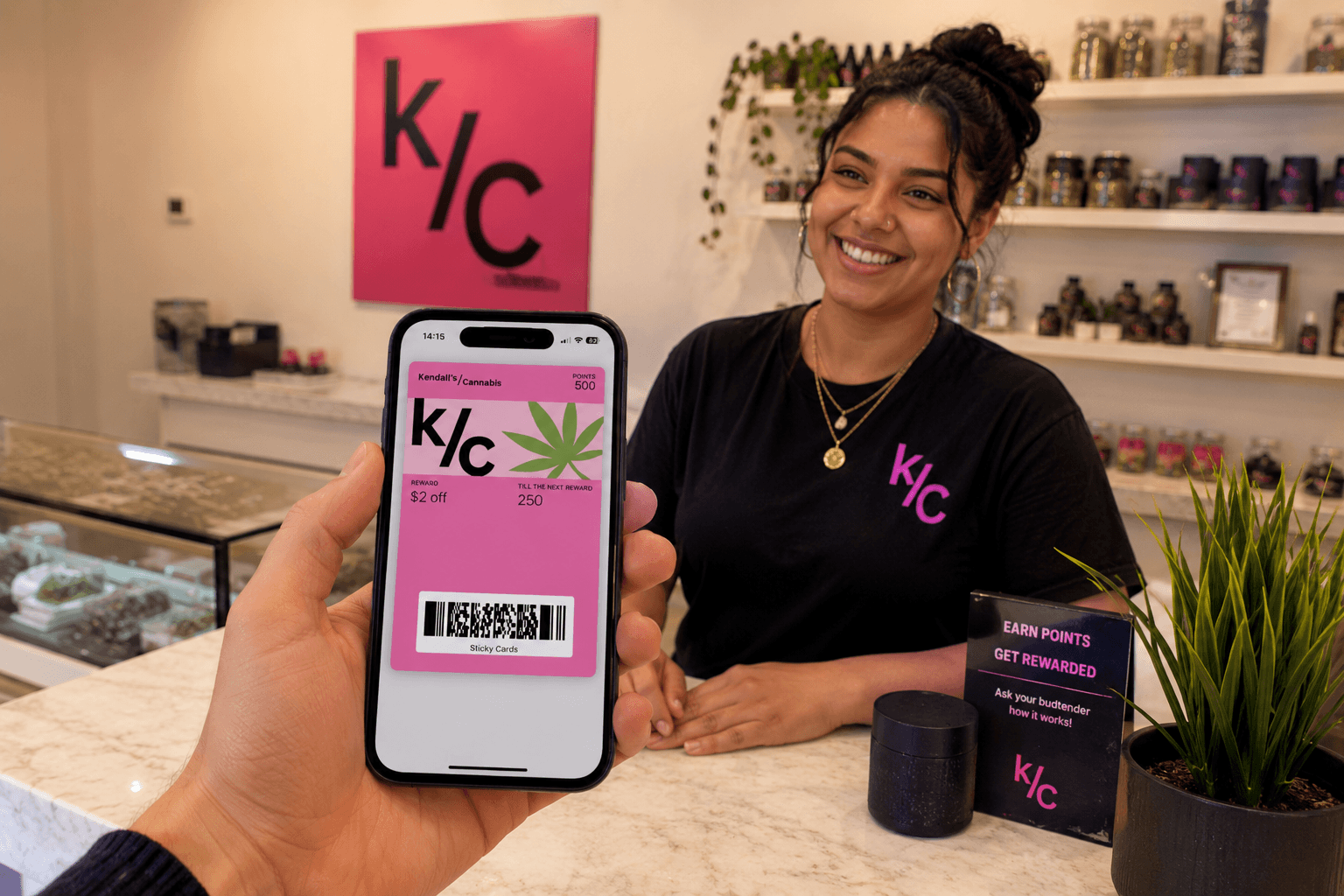
This is exactly the problem Sticky Cards was built to solve - wallet-pass loyalty enrollment that takes about ten seconds, with no app to download, so you capture more customers into the high-CLTV segment.
How to use CLTV in your dispensary
Once you've calculated your CLTV, here's how to actually put it to work.
Set your customer acquisition budget. A common rule of thumb is that you should spend no more than one-third of CLTV to acquire a customer. If your CLTV is $2,000, you can comfortably spend up to ~$650 to acquire a new customer and still come out well ahead. Most dispensaries spend far less than that, which usually means they're under-investing in acquisition.
Justify your loyalty program spend. If your loyalty platform costs a few hundred dollars a month and it converts even a handful of non-members into members - each worth thousands more in CLTV - the program pays for itself many times over. Compare what loyalty actually costs against the CLTV lift it generates, and the math is rarely close.
Prioritize retention over acquisition. Because lifespan is the most powerful CLTV lever, dollars spent keeping existing customers usually outperform dollars spent finding new ones. Win-back campaigns, push notifications, and tiered loyalty rewards all extend customer lifespan.
Segment your customers by CLTV. Not all customers are worth the same. Calculate CLTV for your top 20% of customers separately, and you'll often find they're worth 5-10× the average. Those are the customers to protect at all costs.
Frequently Asked Questions
What is customer lifetime value for a dispensary?
Customer lifetime value (CLTV) for a dispensary is the total gross profit a single customer generates over the entire time they shop at your store. It's calculated by multiplying average purchase value, annual purchase frequency, customer lifespan in years, and gross margin. CLTV tells you how much you can afford to spend acquiring and retaining each customer.
How do you calculate CLTV for a cannabis dispensary?
To calculate CLTV for a cannabis dispensary, use the formula: Average Purchase Value × Purchase Frequency × Customer Lifespan × Gross Margin. For example, a customer with a $55 average basket who visits 28.8 times per year, stays 2.5 years, at a 50% gross margin has a CLTV of $2,000.
What's a good customer lifetime value for a dispensary?
A good CLTV varies by market and store size, but typical dispensary CLTV ranges from a few hundred dollars for occasional non-member customers to well over $2,000 for engaged loyalty members. The more useful comparison is your own loyalty members vs. non-members - members commonly have 3× or higher CLTV than non-members.
How can a dispensary increase customer lifetime value?
The most effective way to increase dispensary CLTV is to improve retention, since customer lifespan is the single most powerful variable in the CLTV formula. Loyalty programs, push notification engagement, win-back campaigns, and tiered VIP rewards all extend customer lifespan and increase visit frequency, which are the two largest drivers of CLTV.
Why do loyalty members have higher CLTV than non-members?
Loyalty members have higher CLTV because joining a loyalty program increases all three of the key CLTV variables: members visit more frequently, they stay customers longer, and they often spend more per visit. The combined effect commonly makes a loyalty member worth three times or more what a non-member is worth over their lifetime.
How much should a dispensary spend to acquire a customer?
A common guideline is to spend no more than one-third of customer lifetime value to acquire a new customer. If your dispensary's CLTV is $2,000, you can spend up to roughly $650 per acquisition and still maintain healthy unit economics. Most dispensaries spend far less, which often indicates they're under-investing in growth.
What's the difference between CLTV and average order value?
Average order value (AOV) is how much a customer spends in a single transaction. CLTV is the total profit a customer generates across all their transactions over their entire lifespan. AOV is one input into the CLTV calculation - CLTV is the much bigger, more strategic picture.