Why one extra visit per customer per year can be worth more than your entire new-customer acquisition budget, and how to run the numbers for your own store.
Reading time: ~6 minutes.
TL;DR
Repeat visits are the most underrated growth lever in cannabis retail. A small increase in how often each customer returns produces an outsized increase in revenue, because it compounds across your entire customer base.
The core equation is simple: Revenue = Customers × Visits per Customer × Average Spend per Visit. Most owners obsess over the first number and ignore the second.
Adding one extra visit per customer per year can rival or exceed the revenue from a major acquisition push - at a fraction of the cost.
Repeat visits are cheaper to generate than new customers, because you already have the relationship, the contact permission, and the data.
The fastest way to drive repeat visits is a frictionless loyalty program with reliable messaging - the engine that turns a one-time buyer into a regular.
The number most dispensary owners ignore
Ask a dispensary owner how they plan to grow, and most will say some version of "get more customers." More foot traffic, more signups, more first-time buyers.
That instinct isn't wrong, but it's incomplete, and it usually focuses on the most expensive lever available.
Your revenue is governed by a simple equation:
Revenue = Number of Customers × Visits per Customer × Average Spend per Visit
There are three levers in that equation, not one. You can grow by adding customers, by getting each customer to visit more often, or by increasing how much they spend per visit. Most owners pour energy and budget into the first lever, acquisition, while almost entirely ignoring the second.
That's a mistake, because the middle lever is usually the cheapest to move and the fastest to compound. This post is about the math behind it.
Why repeat visits compound
Here's what makes repeat visits so powerful: an improvement to visit frequency multiplies across your entire customer base at once.
When you acquire a new customer, you've added one customer. When you increase visit frequency, you've improved the value of every customer you already have, simultaneously.
Let's make that concrete. Imagine a dispensary with these numbers:
2,000 active customers
Each visits 18 times per year on average
Average spend per visit: $55
Annual revenue = 2,000 × 18 × $55 = $1,980,000
Now, what does it take to grow that by 10%?
Option A - grow through acquisition. You'd need to add 200 brand-new customers (a 10% increase in your customer base), each visiting and spending at the same rate. In a competitive market with expensive, restricted cannabis acquisition channels, adding 200 net-new active customers is a serious, costly undertaking.
Option B - grow through repeat visits. You'd need each existing customer to visit just 1.8 more times per year - roughly one extra visit every seven months.
2,000 × 19.8 × $55 = $2,178,000 (a 10% increase)
Both options grow revenue by the same $198,000. But one requires acquiring 200 new customers through restricted, expensive channels. The other requires nudging your existing, already-opted-in customers to come back slightly more often.
For most dispensaries, Option B is dramatically cheaper and faster.
The repeat-visit math, step by step
Let's run the calculation for your own store. You'll need three numbers from your POS.
Step 1: Find your current visit frequency
Take your total transactions over a year and divide by your number of unique customers.
Example: 36,000 annual transactions ÷ 2,000 unique customers = 18 visits per customer per year
Step 2: Find your average spend per visit
Take your total revenue and divide by total transactions.
Example: $1,980,000 ÷ 36,000 transactions = $55 per visit
Step 3: Model the impact of one more visit
Multiply your customer count by your average spend, then by the number of extra visits you want to model.
One extra visit per customer per year: 2,000 customers × 1 visit × $55 = $110,000 in additional annual revenue
That's the headline number: in this example, one additional visit per customer per year is worth $110,000. And because it applies to every customer at once, you don't have to acquire anyone to get it.
Step 4: Compare it to your acquisition cost
Now ask: what would it cost to generate that same $110,000 through acquisition?
$110,000 ÷ $55 per visit ÷ 18 visits per year = 111 new customers needed At even a modest $50 acquisition cost each = $5,550+ and that's a conservative cannabis acquisition cost
The repeat-visit path typically costs a fraction of the acquisition path, because you're marketing to people who already know you, already opted in, and are already in your database.
The frequency-revenue table
Here's how the math scales. Using the same example dispensary (2,000 customers, $55 average spend), this is what each increment of extra visits per customer is worth annually.
Extra visits per customer/year | Additional annual revenue | Equivalent new customers needed |
|---|---|---|
+0.5 visits | $55,000 | ~56 customers |
+1 visit | $110,000 | ~111 customers |
+2 visits | $220,000 | ~222 customers |
+3 visits | $330,000 | ~333 customers |
+4 visits | $440,000 | ~444 customers |
Look at the bottom row. Getting each customer to visit four more times a year - less than one extra visit per quarter - generates the same revenue as acquiring 444 brand-new customers. That's the power of compounding across your base.
Why repeat visits are cheaper than new customers
There's a structural reason repeat-visit marketing outperforms acquisition marketing in cannabis specifically.
You already have permission to contact them. A repeat customer who's opted into your loyalty program can be reached directly. A new customer has to be found through restricted, expensive channels, and cannabis operators can't use most mainstream paid advertising.
You already have the data. You know what your existing customers buy, when they last visited, and what brings them back. You can target them precisely. A new customer is a cold prospect.
The relationship already exists. A repeat customer has already decided they like your store. You're nudging an existing preference, not building one from scratch.
The channel costs are lower. Reaching an existing customer through a push notification costs effectively nothing per message when sent through a wallet pass, versus the per-message SMS fees and broadcast ad costs of acquisition.
This is why the dispensaries that grow most efficiently aren't necessarily the ones spending the most on acquisition. They're the ones who've built a reliable engine for bringing existing customers back.
How to actually drive more repeat visits
Knowing the math is one thing. Moving the number is another. Here are the levers that reliably increase visit frequency, roughly in order of impact.
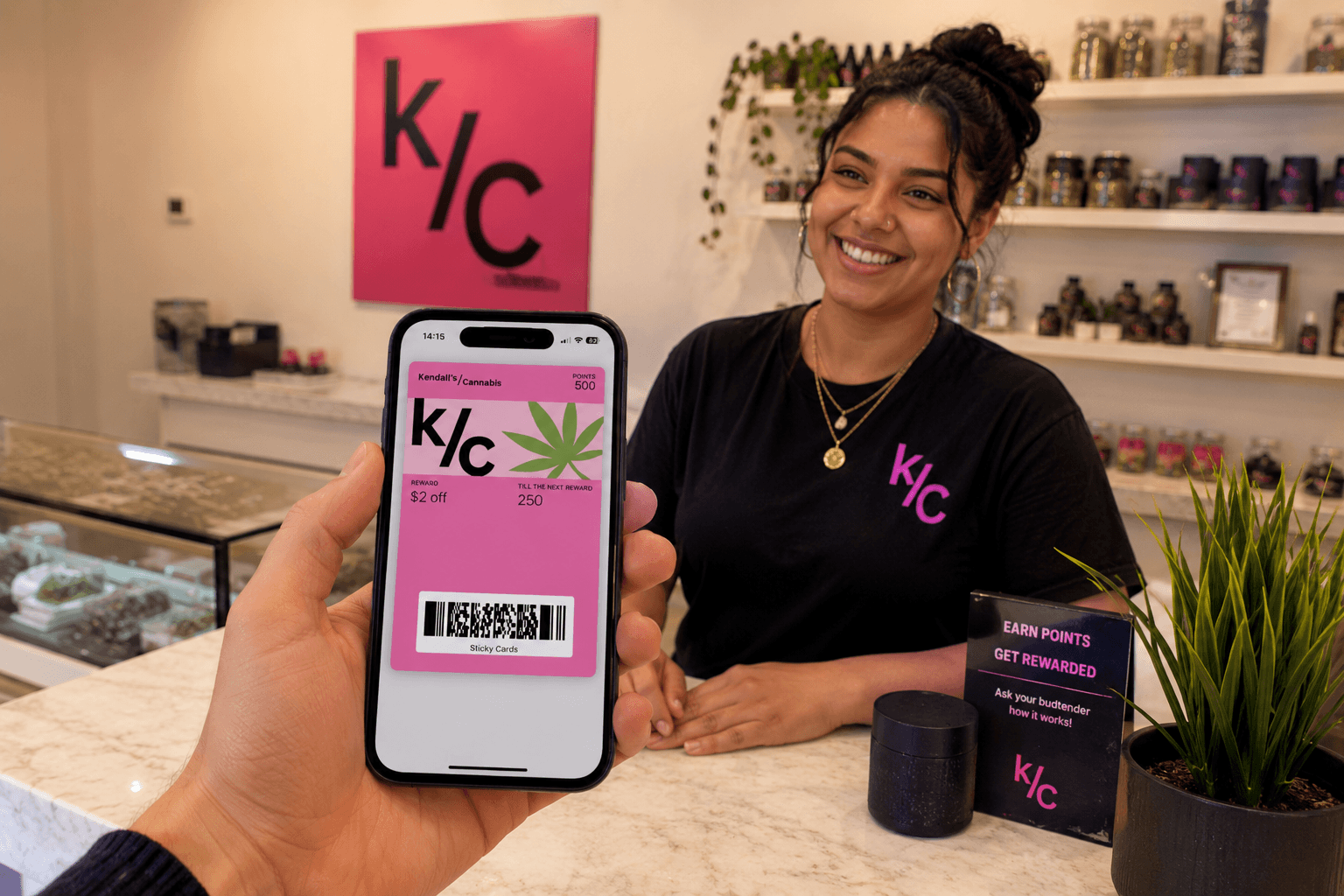
Run a loyalty program with frictionless enrollment. This is the foundation. A loyalty program gives customers a reason to return (accumulating points or rewards) and gives you permission to contact them. The catch is enrollment friction - if joining is hard, most customers won't, and you lose the channel before it starts. Wallet-pass loyalty like Sticky Cards solves this by making enrollment a ten-second QR scan with no app to download.
Send well-timed, relevant messages. A customer who hasn't visited in three weeks is a prime candidate for a gentle nudge. A customer celebrating a birthday is a prime candidate for an offer. Automated, behavior-triggered messaging keeps your store top-of-mind without requiring manual effort.
Use push notifications instead of SMS where possible. Push notifications sent through Apple Wallet and Google Wallet reach the lock screen reliably, without the carrier filtering that blocks a meaningful share of cannabis SMS. Higher delivery means more of your "come back" messages actually land.
Reward frequency directly. Build your loyalty mechanics to reward visits, not just spend. Stamp cards, visit streaks, and "visit 3 times this month" challenges all explicitly target the frequency lever.
Re-engage lapsed customers. Every dispensary has a long tail of customers who visited a few times and drifted away. A targeted win-back campaign to customers who haven't visited in 60+ days often produces a better return than any acquisition campaign - they're not gone, they just need a reason to come back.
Make every visit worth repeating. None of the above matters if the in-store experience doesn't earn the return. Frequency marketing amplifies a good experience; it can't rescue a bad one.
For a deeper look at how frequency feeds into the bigger picture of customer value, see our companion guide on calculating customer lifetime value for dispensaries - visit frequency is one of the two biggest drivers of CLTV.
Frequently Asked Questions
What is repeat-visit math for a dispensary?
Repeat-visit math is the calculation of how much additional revenue a dispensary generates when each customer visits more frequently. Because an increase in visit frequency applies across the entire customer base at once, even a small increase — like one extra visit per customer per year — can produce substantial revenue gains, often rivaling a major customer acquisition effort at a fraction of the cost.
How much is one extra customer visit worth?
The value of one extra visit per customer per year equals your number of customers multiplied by your average spend per visit. For a dispensary with 2,000 customers and a $55 average basket, one extra annual visit per customer is worth $110,000 in additional revenue. The exact figure scales with your specific customer count and average spend.
Is it cheaper to get repeat visits or acquire new customers?
For most dispensaries, generating repeat visits is significantly cheaper than acquiring new customers. Repeat-visit marketing targets people who have already opted in, are already in your database, and already have a relationship with your store — so you avoid the high, restricted acquisition costs that cannabis operators face on most paid channels.
How do you calculate dispensary visit frequency?
To calculate dispensary visit frequency, divide your total annual transactions by your number of unique customers. For example, 36,000 transactions divided by 2,000 unique customers equals 18 visits per customer per year. This number is one of the most important and most overlooked metrics in dispensary growth.
What's the best way to increase repeat visits at a dispensary?
The most effective way to increase repeat visits is a loyalty program with frictionless enrollment paired with reliable, well-timed messaging. Wallet-pass loyalty enrollment, behavior-triggered push notifications, frequency-based rewards, and win-back campaigns for lapsed customers all directly target visit frequency, which is the highest-leverage growth lever for most dispensaries.
Why do repeat visits matter more than average order value?
Both matter, but repeat visits are often easier to move and compound faster. Increasing visit frequency multiplies across your entire customer base simultaneously and can be driven through low-cost owned channels like loyalty messaging. Average order value increases are valuable too, but they typically require changing purchasing behavior on a per-transaction basis, which is harder to influence at scale.